
Laboratory Safety
Lithium-ion Battery Safety: A Vital Reminder For Users
Lithium-ion batteries (LIBs) are used in many devices—from power tools to EV cars. Recent incidents highlight the serious risks they pose if mishandled. In April 2024, a lithium-ion battery of a cordless drill exploded, causing a fire that resulted in approximately HKD 520,000 (AUD 100,000) in damage to a family home in Melbourne, Australia. The battery was not charging at the time and was simply resting on a table. Commenting on the incident, Fire Rescue Victoria highlighted the risk of fires from damaged or waterlogged batteries and the danger of using incorrect chargers. Fire crews in Victoria respond to several battery-related fires weekly.
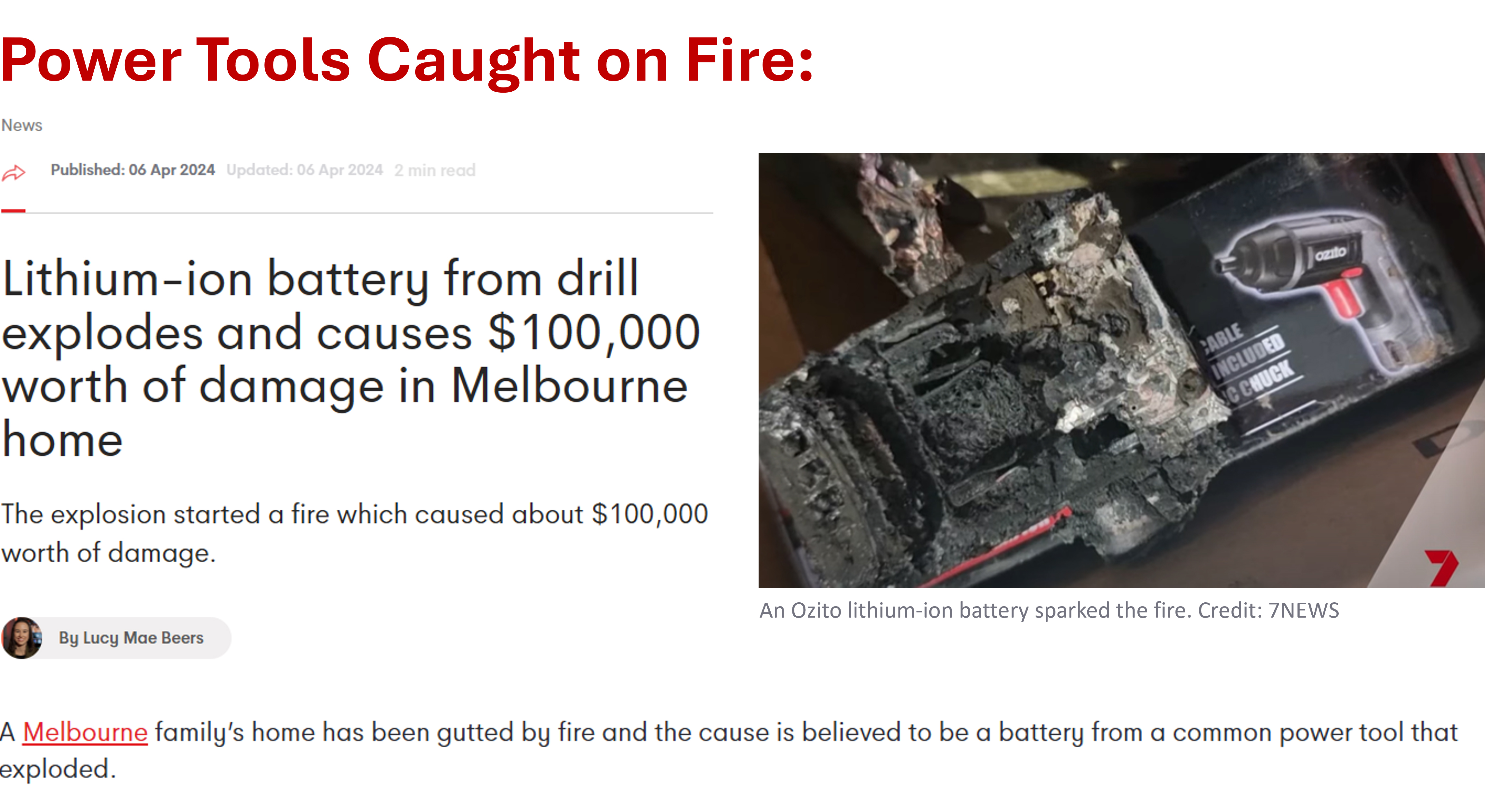
Devastating Incident: Lithium-ion battery from a power tool sparks a fire, causing extensive damage and AUD 100,000 (HK$ 520,000) in losses for a Melbourne family.
In a separate report, statistics from Fire and Rescue New South Wales (FRNSW) in Australia show a troubling increase in LIB-related fires in Australia, often involving chargers, e-bikes, and power tools.
Source: LITHIUM-ION BATTERY INCIDENTS 2022-2023
As a leading institution with numerous innovative projects and research activities, HKUST faces similar risks, and it is important for users to adopt appropriate safe use practices to mitigate such risks.
At HKUST, lithium-ion batteries are integral to a wide range of activities, including student projects, innovative research, and makerspace creations involving drones, electric vehicles, and remote-controlled devices. These batteries power essential tools and groundbreaking technologies across campus.

Additionally, HKUST is engaged in cutting-edge research on advanced materials for manufacturing lithium-ion batteries, pushing the boundaries of energy efficiency and safety. With their extensive use and ongoing research, it is crucial to understand the associated risks and implement proper safety measures.
Understanding Lithium-Ion Battery Hazards
Lithium-ion batteries (LIBs) are powerful energy sources, but they come with significant hazards that are crucial to understand for safe handling. These batteries contain flammable electrolytes that can ignite under certain conditions, leading to fire, explosion, thermal runaway, and the release of toxic gases.
Source: 1. ICHCA Battery Safety Week (Webinar, 2022); 2. ICHCA Coffee Break (Webinar, 2022)

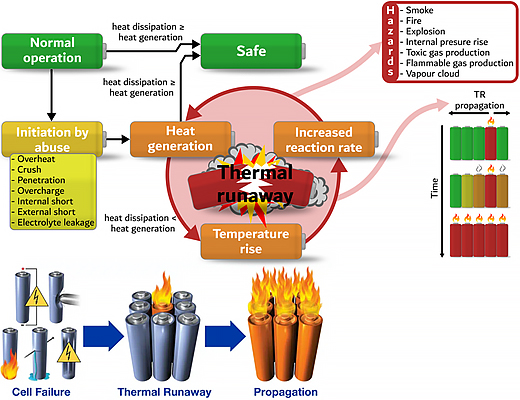
The Mechanism of Lithium-Ion Battery Fires
A lithium-ion battery does not require oxygen to ignite; it can sustain combustion independently, making extinguishing efforts more complex. Abuse scenarios—such as overheating, crushing, or overcharging—initiate a series of reactions that lead to temperature rise and heat generation, eventually triggering thermal runaway. Once initiated, thermal runaway propagates rapidly, with limited methods available to suppress or contain the fire effectively.
The National Fire Protection Association (NFPA) recommends firefighters using water as cooling agent to control lithium-ion battery fires1. Recent reviews2,3 support this approach, highlighting water mist as one of the most effective methods for limiting the heat that drives thermal runaway. However, these reviews also point out that there is no universal solution due to the complexity of thermal runaway, the wide range of LIB configurations, and the toxic gases emitted during suppression.
The re-ignition potential of LIBs and the complexity on effective extinguishing methods make handling these batteries particularly challenging. Fire suppression in LIB incidents often requires specialized equipment and protocols, which highlights the importance of preventive measures to avoid triggering thermal runaway or other failure modes.
Essential Safety Tips for Lithium-Ion Battery Use, Charging, and Storage
Whether in makerspaces, research labs, or even personal devices, these batteries need to be treated with care. Here are some key guidelines:
Use
|
Charge
|
Storage
|
Transport
|
Source: 1. NFPA Lithium-Ion Battery Safety Tip Sheet; 2. How to Properly Ship Lithium-Ion Batteries
Lithium-ion batteries are widely used across the HKUST campus due to their high energy in compact forms. However, their potential for spontaneous fires or explosions when overheated underscores the importance of understanding their hazards. Fostering a safe environment is integral as we uphold a culture of innovation and sustainability. Through continuous education and vigilance, we can ensure that progress and safety move forward together, protecting our entire community.
For more information on risk assessment and safe use practice of Lithium battery for operations or research, contact Dr Cell WONG at 2358 6507.
Reference
- National Fire Protection Association, “Lithium-Ion Battery Safety: FAQ,” [Online]. Available: https://www.nfpa.org/education-and-research/home-fire-safety/lithium-ion-batteries. [Accessed: Nov. 15, 2024].
- S. Yuan, C. Chang, S. Yan, P. Zhou, X. Qian, M. Yuan, and K. Liu, “A review of fire-extinguishing agent on suppressing lithium-ion batteries fire,” Journal of Energy Chemistry, vol. 62, pp. 262-280, 2021.
- M. Ghiji, V. Novozhilov, K. Moinuddin, P. Joseph, I. Burch, B. Suendermann, and G. Gamble, “A Review of Lithium-Ion Battery Fire Suppression,” Energies, vol. 13, no. 19, p. 5117, 2020.